June 20, 2026
Everything About Memorization

About the author
Developer of Kiokuma
A fifth-year medical student and the developer of the flashcard app Kiokuma. Drawing on years of exams and medical school, I share thoughts on memorization and studying every day.
From memorizing to understanding.
Download on the App Store
Your memorization method is something only you can find
Search for "the most efficient way to memorize" and you get an overwhelming flood of information. Spaced repetition, mnemonics, mind maps, flashcards — all of them have some evidence behind them, and there are people who genuinely feel they work. Yet for a long time I read through all of it and couldn’t apply any of it to my own studying.
I now understand why. How you memorize something depends enormously on the subject. Memorizing terms from a foreign language, memorizing physiological mechanisms, memorizing chemical equations — each one uses your brain differently. On top of that, even within one person, the format of memory that comes easiest is partly fixed: some people do well with rhymes and mnemonics; others need a diagram.
In other words, there is no single "best memorization method," and someone else’s experience doesn’t automatically apply to you. In the end, all you can do is put in a certain amount of volume and, along the way, discover what works for you. That might sound like a roundabout answer, but I believe it’s the only real shortcut.
Efficiency is something that comes later
Take learning medical terminology as an example.
Ask a doctor or experienced medical student how they approach unfamiliar terms, and they’ll often say: once you know the Latin and Greek roots, you can decode almost anything. If you know that -itis signals inflammation, that cardio- relates to the heart, and that myo- means muscle, then myocarditis — inflammation of the heart muscle — is something you can derive rather than memorize.
This is true. It really is. But tell that to a first-year student seeing these terms for the first time, and it lands as a shrug. They can’t feel why it matters yet.
The root-pattern insight only clicks after you’ve already forced hundreds of terms into your head by brute force. There’s a moment when scattered points suddenly connect — "oh, if -ectomy means surgical removal, and nephro- means kidney, then nephrectomy must be..." Only after that experience does pattern learning become a weapon you can actually use.
In other words, efficient memorization lies on the far side of a certain amount of volume. Chase efficiency from the start and you give up with "I just can’t remember this" while your volume is still nowhere near enough.
When scattered points connect into a line
I’m now a fifth-year medical student. Counting from my exam-prep days, I’ve been facing memorization for years. As a ronin I ground through problem sets, and in medical school I made it through a big exam called the CBT. I’d say I’ve done a fair share of memorizing.
And yet there are still moments when I wonder, "What’s the best way to actually remember this?" Medical knowledge in particular is enormous, and the sheer variety of things you have to memorize is huge.
Here’s something I noticed studying medicine: memorization gradually burns itself in through the experience of being asked about the same knowledge from different angles.
Take the structure of the skin. There are layers — the epidermis and the dermis — and blood vessels run only through the dermis, while the epidermis contains only nerves. You memorize that by rote. (The epidermis is the outermost layer; the dermis sits beneath it.)
Then a question comes: "How deep does a wound go if it isn’t bleeding?" Reasoning from what you just memorized, since it hasn’t reached the dermis where the vessels are, it must stop at the epidermis. The same logic applies to the classification of burn depth.
By hitting these "same idea, different angle" questions over and over, knowledge that was scattered starts linking up into a system. The moment memorization turns into understanding almost always comes from that feeling of "ah, this connects to the earlier thing."
Once you’ve had that experience, the fact sticks far more powerfully than seeing the same text five times — it simply becomes harder to forget.
"I’m bad at memorizing" is at least partly a question of effort
I once had the chance to tutor a middle school student as a volunteer. One kid said they "absolutely couldn’t remember English words," so I asked how they were studying.
They’d look at the words the teacher gave them, look at them again at cram school — and that was about it. They touched each word maybe two or three times, at most.
My honest reaction was that of course you can’t remember a word that way. For me, it takes repeating a single word five or ten times before it finally sticks. Even in medical school, I’ve seen a few classmates who memorize astonishingly fast — and even they review the same things again and again.
Most people who say they’re "bad at memorizing" are probably just not repeating things enough. (Exactly how many repetitions it takes differs from person to person, of course.)
Plenty of people believe muscles grow if you train them, yet for some reason many assume memory is fixed from birth. Study consistently, and your memory might just get better too.
A survey of memorization methods
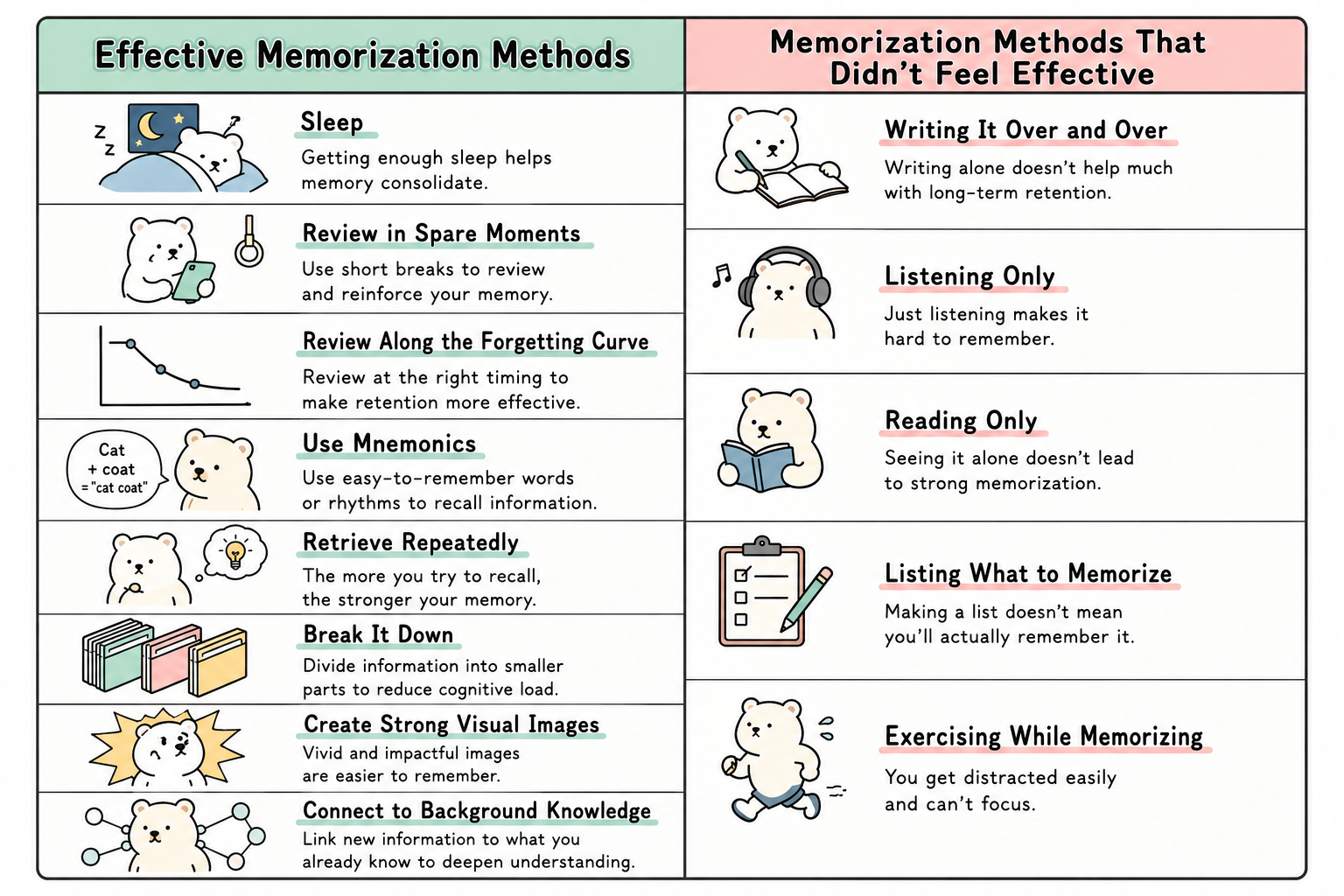
What follows is an honest account of methods I’ve personally found highly effective — and ones that didn’t do much for me. Everyone will find some that click and some that don’t, so treat this as a menu to experiment from.
One general principle worth keeping in mind: the harder a study method feels in the moment, the more effective it tends to be. The more comfortable a method is, the weaker the result — and my experience lines up strongly with that.
On studying in spare moments — a nuanced take
This one is half right and half wrong, in my view. Reviewing flashcards during a break is perfectly fine. But trying to memorize something you’ve never seen before — like tackling a new page of a vocabulary book — in a spare five minutes is a bad idea.
Brand-new knowledge requires you to sit down and genuinely engage with it. On a train or between classes, background noise and time pressure scatter your focus, and you end up just vaguely glancing at the material. Spare moments should be used exclusively to consolidate knowledge you’ve already put in once. The brain isn’t convenient enough to absorb completely new material on the fly.
Sleep
This is the most powerful method I know. Cram things into your head right before bed, then review them in the morning.
Why it works: during sleep, your brain runs a process of sorting and consolidating memories. Information you encounter right before sleeping is reportedly processed more effectively by that night’s sleep cycle. The result is that when you look back at it in the morning, you’re often surprised by how much you retained.
One tip: mix in some review of the day’s earlier material alongside the new content you’re adding before bed. Pure first-exposure material alone tends to stick less well than a blend of something you’ve touched before and something new. And obviously, cutting into sleep time to cram more is counterproductive — a full night’s sleep is a non-negotiable prerequisite.
Spaced repetition
This one is genuinely useful. Ebbinghaus’s forgetting curve describes how people forget information rapidly right after learning it, but reviewing at well-timed intervals makes the memory progressively more durable.
The first few encounters with something are rough — you may need to force it into your head repeatedly and it still won’t feel like it’s taking hold. But around the fourth or fifth time, something shifts. The review intervals start stretching out, and you begin to recall things almost spontaneously — "oh, I’ve seen this before." Keep going and you’ll start connecting facts to everyday experiences or to other knowledge: "wait, these two things work on the same principle." Once you reach that stage, forgetting becomes rare.
Managing the schedule manually is tedious, so using an app is the practical move. Something that automatically surfaces what you need to review and when lets you direct your mental energy toward the actual memorization.
Mnemonics
For anything that stubbornly refuses to stick, a mnemonic is the way through. The classic example from Japanese chemistry class is a rhyme that encodes the first elements of the periodic table in order — something like "sui hē rī bē, boku no fune" (H, He, Li, Be…).
The real strength of a mnemonic is that it encodes order alongside content. That rhyme doesn’t just give you the element names — it gives them to you in atomic-number sequence. Trying to memorize a list as-is tends to leave you thinking "what was the third one again?", whereas a mnemonic gives you a thread to pull on: "...the ship, so next is..."
Medical students often inherit mnemonics from seniors, but the ones you improvise on the spot for your own use can get quite colorful. It’s a well-known ritual to skim through old exams before passing them to juniors, just to catch any mnemonic annotations that would be too embarrassing to leave in. Which suggests that the more outrageous the mnemonic, the more stubbornly it lodges in the brain.
Active recall
This is hard, but it works. After finishing a study session, try — in the bath, in bed, wherever you’re drifting — to actively reconstruct from memory what you just studied. No notes, no book: just your own head, trying to replay "this was like this, then this..."
Why it’s hard: you can’t recall things. Even material you studied minutes ago comes out patchy and incomplete. That’s exactly the point. The struggle to retrieve something — and the friction of not quite getting it — is what strengthens the memory. This is sometimes called the testing effect. Attempting to recall without looking beats re-reading in terms of long-term retention.
Doing this in the bath or in bed has a bonus: the gaps you notice naturally tell you what to prioritize in tomorrow’s review.
Chunking
A phone number like 09012345678 is harder to hold than 090-1234-5678. This is chunking: dividing information into meaningful clusters to reduce the load on working memory.
It applies to terminology too. "Cardiomyopathy" looks intimidating at first glance, but "cardio / myo / pathy" — heart, muscle, disease — breaks into three meaningful handles. Once you build up a bank of roots this way, unfamiliar terms stop feeling like walls and start feeling like puzzles.
Before diving into memorization, spending a moment to ask "where can this break apart?" or "what does this share with something else?" makes a meaningful difference in how efficiently it sticks.
Generating vivid images with AI
For things that simply refuse to stay in your head, try asking an AI to generate a striking image that represents the concept — "make an image for this word that’s so weird and impactful I can’t forget it." The results are often surprisingly memorable.
Why images work: the brain retains visual material more readily than text. And the more extreme the image, the better. Slightly absurd, a little grotesque, genuinely funny — memories tied to emotion or sensation tend to stick more firmly.
That said, generating images takes time, so reserve this for the genuinely stubborn cases. If you try to make an image for every single item, the image-making becomes the goal instead of the memorization.
Building background knowledge and making connections
When memorizing historical dates and events, knowing that Columbus reached the Americas in 1492 is harder to retain in isolation than when you also know the state of Europe at the time and why Spain was willing to fund the voyage — then it becomes something you can reconstruct like a chain.
Researching background context is extra work, and the impulse to just brute-force memorize first is understandable. But knowledge crammed in without any context tends to evaporate within a month, and you end up re-learning it anyway. Investing a little time upfront in understanding why something is the way it is usually results in shorter total study time.
This is especially true in medicine: if you understand the mechanism of a disease, the symptoms and treatments follow naturally. Understanding-first beats rote memorization by a wide margin.
Methods I wouldn’t particularly recommend
Writing things out
Writing to confirm how a word is spelled has its place. But re-writing everything by hand every time you review is unnecessary. Writing is slow, and its contribution to memory is lower than it feels like it should be. The same time spent actively pulling information out of your head is more effective. The trap is that writing creates a strong sense of "I’m studying," while your brain coasts along on autopilot.
Passive reading
To be clear: looking at a question, generating an answer in your head, then checking — that’s effective. The problem is pure reading: running your eyes over text. It’s easy to come away feeling like you remember something when you don’t. "I just read it, so why can’t I recall it?" usually traces back to this. Reading alone doesn’t build the retrieval cue.
Listening
Using audio for listening comprehension in a target subject is fine as a skill-building exercise. As a memorization tool, though, it’s inefficient — the information density is low and it’s easy to drift into passive background listening. The idea that you can absorb material by playing recordings while you sleep has never produced any effect for me personally.
Making neat notes
Organizing material into notes is reasonable if it’s quick. The problem is spending hours on a beautiful, color-coded summary. The goal is to remember things, not to produce a notebook. The worst pattern is finishing the notes, feeling satisfied, and realizing you’ve retained almost nothing. The notebook became the destination.
Studying while exercising
I genuinely couldn’t make this work. Articles recommending audio materials on walks are common, and there’s real research suggesting exercise benefits cognition. But personally, I never felt information land when I was walking and listening. This one seems to vary quite a bit between people — if it clicks for you, consider it a bonus. If it doesn’t, don’t worry about it.
In short: to memorize well, do the volume first
What I want to tell people searching for the efficient way to memorize sounds contradictory at first: do the volume first.
At the beginning, root-pattern tricks and the forgetting curve are things you can know as facts but not yet feel. As you pile up volume, the moment comes when scattered points connect into a line. Only then does "efficient memorization" finally become your own.
Efficiency comes later. Doing the volume without second-guessing it — that, I believe, is the real shortcut, even if it looks like the long way around.